
≡ Menu

Turbocharge Your App with React Lazy Loading 🚀


Ever noticed a web page that seems to take forever to load, especially on a slower connection?

That sluggishness often comes from loading all the code for every component right when the app starts.

But what if you could load only what you need, when you need it? That’s where React lazy loading comes in!

Lazy loading is a powerful technique to significantly improve your application’s initial load time and overall performance.

It essentially lets you split your application’s code into smaller bundles, only loading them on demand.

The Problem: Large Bundles

React apps, especially large ones, can result in a massive single JavaScript bundle. When a user first visits your site, their browser has to download, parse, and execute this entire bundle before they see anything, leading to a poor Time to Interactive score.

The Solution: React.lazy and Suspense


React provides two built-in tools for easy code-splitting and lazy loading:

  1. React.lazy(): This function makes it easy to render a dynamic import as a regular component. It takes a function that must call a dynamic import() to load the component.
    const MyLazyComponent = React.lazy(() => import('./MyComponent'));
    
  2. <Suspense>: Since the lazy component might take a moment to load, you need a way to show the user that something is happening. The <Suspense> component is what handles this suspense! It wraps your lazy components and allows you to display a fallback UI—like a spinner or a loading message—while the component’s code is being loaded.
    import React, { lazy, Suspense } from 'react';
    
    // ... define MyLazyComponent as above
    
    function App() {
      return (
        <div>
          <h1>Welcome!</h1>
          <Suspense fallback={<div>Loading...</div>}>
            <MyLazyComponent />
          </Suspense>
        </div>
      );
    }
    

Practical Applications


So, where should you use lazy loading? It’s typically most effective for:

  • Routes/Pages: This is the most common use case. If a user is on the homepage, they don’t need the code for the admin dashboard or the checkout page yet. Using lazy loading on your routes (often with a router like React Router) is the best way to leverage performance gains.
  • Large, Infrequently Used Components: Think of a complex modal, a huge chart, or an editor that’s only accessed by a small number of users or only after a button click.

By intelligently splitting your bundles, you deliver a much snappier, more enjoyable experience to your users. Go ahead, give your app a performance boost with lazy loading!

Useful links below:

Let me & my team build you a money making website/blog for your business https://bit.ly/tnrwebsite_service

Get Bluehost hosting for as little as $1.99/month (save 75%)…https://bit.ly/3C1fZd2

Join my Patreon for one-on-one coaching and help with your coding…https://www.patreon.com/c/TyronneRatcliff

Buy me a coffee ☕️https://buymeacoffee.com/tyronneratcliff
{ 0 comments }
AI wars

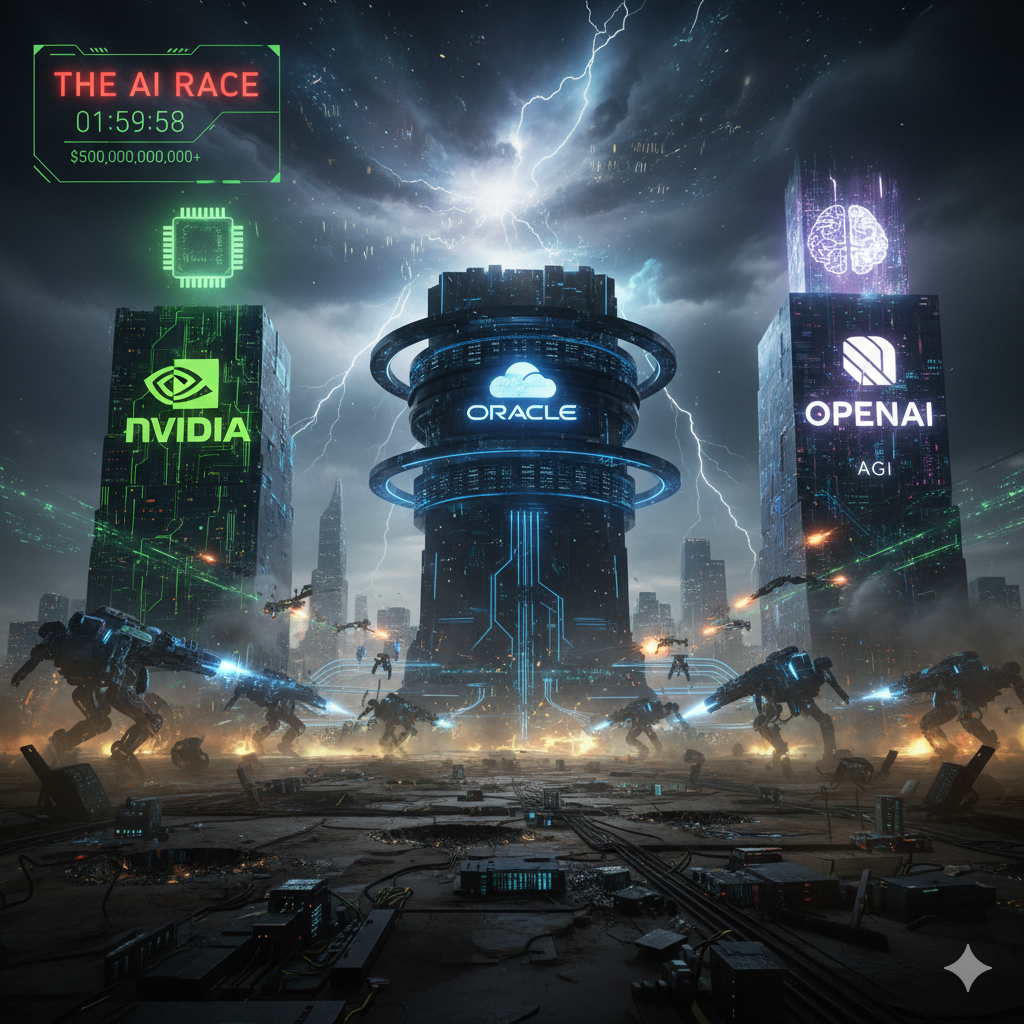
The current AI race is being defined by massive, multi-billion dollar strategic alliances focused on building the computational infrastructure necessary for the next generation of artificial intelligence. At the center of this rapid build-out are Nvidia, Oracle, and OpenAI, whose interlocking partnerships underscore a collective push toward “superintelligence.”


The Core Players and Their Roles

Company Core Role in the AI Race Key Initiative/Partnership
OpenAI AI Innovator and Model Developer Pushing the frontier of AI models (like ChatGPT) toward Artificial General Intelligence (AGI).
Nvidia AI Infrastructure Backbone Dominant supplier of the GPUs and systems critical for training and running advanced AI models.
Oracle Cloud and Data Center Provider Providing the physical cloud infrastructure, power, and data center capacity for massive AI projects.

OpenAI and the Compute Arms Race

OpenAI, the creator of ChatGPT, is in a perpetual quest for more compute—the foundational power needed to train its increasingly complex models and serve its hundreds of millions of users. CEO Sam Altman emphasizes that “everything starts with compute,” positioning infrastructure as the basis for the future economy. To secure this capacity, OpenAI has formed two monumental deals:

  • Nvidia Partnership: A strategic, non-binding letter of intent was recently announced for OpenAI to deploy at least 10 gigawatts (GW) of AI data centers powered by Nvidia systems. Nvidia plans to invest up to $100 billion in OpenAI, progressively, as the new systems are deployed. This circular-funding mechanism—Nvidia invests, and OpenAI uses the capital to buy Nvidia chips—secures a guaranteed customer for Nvidia and essential, preferential access to cutting-edge hardware for OpenAI.
  • Oracle/SoftBank “Stargate” Project: This is a separate, massive-scale infrastructure program that aims to reach 10 GW of power capacity and a total investment of $500 billion. Oracle is a key partner in this initiative, providing the physical data center capacity and cloud services. The project is expanding rapidly, with Oracle-developed sites accounting for several gigawatts of planned capacity.

Nvidia: The Unchallenged AI Hardware King

Nvidia’s graphics processing units (GPUs) are the gold standard for AI model training, making the company an indispensable player. Its strategy has moved beyond just selling chips; it’s now actively investing to secure the future of the AI ecosystem:

  • Securing Demand: The $100 billion investment in OpenAI locks in its most important customer, solidifying its market dominance against rivals. This co-optimization between OpenAI’s software and Nvidia’s hardware is expected to cement a technology advantage.
  • Controlling the Ecosystem: By also investing $5 billion in Intel and collaborating on next-generation chips, Nvidia is hedging its supply chain and ensuring its core technology is integrated across a broader range of AI systems.

Oracle’s Cloud Gambit

Oracle is leveraging the immense power- and space-requirements of large AI models to reposition itself as a top-tier cloud provider for AI infrastructure. By partnering with OpenAI on the multi-billion dollar Stargate project, Oracle has committed to delivering significant data center capacity. This move positions Oracle as a crucial enabler of the AI race, offering a compelling cloud alternative to giants like Microsoft and Amazon for companies that need massive, dedicated AI compute resources.


Implications for the AI Race

The confluence of these deals signals a new phase in the AI race:

  1. Scale and Cost are King: The staggering figures (up to $100 billion from Nvidia, $500 billion for Stargate) indicate that the pursuit of superintelligence requires industrial-scale infrastructure and capital unprecedented in tech history.
  2. Strategic Dependencies: The partnerships highlight a deepening, mutually beneficial dependence: OpenAI needs Nvidia’s chips, and Nvidia needs OpenAI’s demand to drive its growth. Similarly, OpenAI and its partners rely on Oracle’s ability to quickly build and power data centers.
  3. Regulatory Scrutiny: The “circular” nature of the Nvidia-OpenAI deal, and the sheer market dominance of Nvidia, are likely to draw increased antitrust attention from regulators concerned about fair competition in the AI sector.

The video below features the CEOs of Nvidia and OpenAI discussing their monumental partnership.

Nvidia CEO on the $100 billion investment in OpenAI: This partnership is ‘monumental in size’

This video is relevant as it features the chief executives of both Nvidia and OpenAI explaining the context and scale of their strategic $100 billion infrastructure partnership, which is a major development in the current AI race.


{ 0 comments }