

≡ Menu

“JavaScript doesn’t actually have classes.”

It’s a controversial way to start a technical discussion, but it’s the truth.

While the class keyword arrived with ES6 in 2015, it didn’t change how JavaScript handles inheritance.

It simply put a tuxedo on a function.

Underneath that sleek, modern syntax lies a world of Prototypal Inheritance.

If you want to move from “writing code” to “understanding the engine,” you have to stop thinking in blueprints and start thinking in chains.


1. What is “Syntactic Sugar”?

In programming, “syntactic sugar” refers to syntax designed to make things easier to read or express. It makes the language “sweeter” for humans, but the computer sees the same old logic.

Take a look at these two snippets.

They are functionally identical in the eyes of the JavaScript engine:

The Modern Look (Class)

class Hero {
  constructor(name) {
    this.name = name;
  }
  greet() {
    return `I am ${this.name}`;
  }
}

The Reality (Prototype)

function Hero(name) {
  this.name = name;
}

Hero.prototype.greet = function() {
  return `I am ${this.name}`;
};

2. The Prototype Chain: Delegation, Not Cloning

In traditional Object-Oriented Programming (like Java or C++), creating an instance is like printing a house from a blueprint.

The house gets all the features of the blueprint.

In JavaScript, inheritance is delegation. When you ask an object for a method (like .greet()), JavaScript performs a search:

  1. Local Search: Does the batman object have a greet property? (No)

  2. The Link: It follows the hidden [[Prototype]] link to Hero.prototype.

  3. The Find: Does Hero.prototype have it? (Yes!)

If it wasn’t there, it would keep climbing until it hit Object.prototype, and finally null.


3. The extends Trick

When we use class Dog extends Animal, we aren’t just copying methods. We are wiring two prototypes together.

Behind the scenes, extends does something like this:

Object.setPrototypeOf(Dog.prototype, Animal.prototype);

This creates a multi-level chain. A Dog instance can access its own methods, Dog methods, Animal methods, and Object methods—all through one continuous chain of links.


4. Why Understanding This Matters

Understanding the “sugar” allows you to do things “pure” classes can’t. You can dynamically “live-patch” your code:

const flash = new Hero("The Flash");

// Adding a method to the "Class" AFTER the object was already created
Hero.prototype.run = function() {
  console.log(`${this.name} is zooming!`);
};

flash.run(); // It works! The link stayed live.

In a static class system, you couldn’t just give a “blueprint” a new room and have all existing houses suddenly grow that room. In JavaScript, you can.


Conclusion

Classes are a fantastic tool for readability and organization. They bring safety (like mandatory super() calls and no hoisting) that the old prototype syntax lacked.

However, never forget: JavaScript is objects all the way down. When you use a class, you aren’t building a factory; you’re just building a very sophisticated chain.

Useful links below:

Let me & my team build you a money making website/blog for your business https://bit.ly/tnrwebsite_service

Get Bluehost hosting for as little as $1.99/month (save 75%)…https://bit.ly/3C1fZd2

Best email marketing automation solution on the market! http://www.aweber.com/?373860

Build high converting sales funnels with a few simple clicks of your mouse! https://bit.ly/484YV29

Join my Patreon for one-on-one coaching and help with your coding…https://www.patreon.com/c/TyronneRatcliff

Buy me a coffee ☕️https://buymeacoffee.com/tyronneratcliff
 

{ 0 comments }

If you’ve ever spent an hour debugging a script only to realize that this wasn’t what you thought it was, welcome to the club.

Every JavaScript developer—from bootcamp students to senior engineers—has been bullied by the this keyword at some point.

In most programming languages, this (or self) is straightforward: it refers to the current instance of the class.

In JavaScript? It’s a shapeshifter.

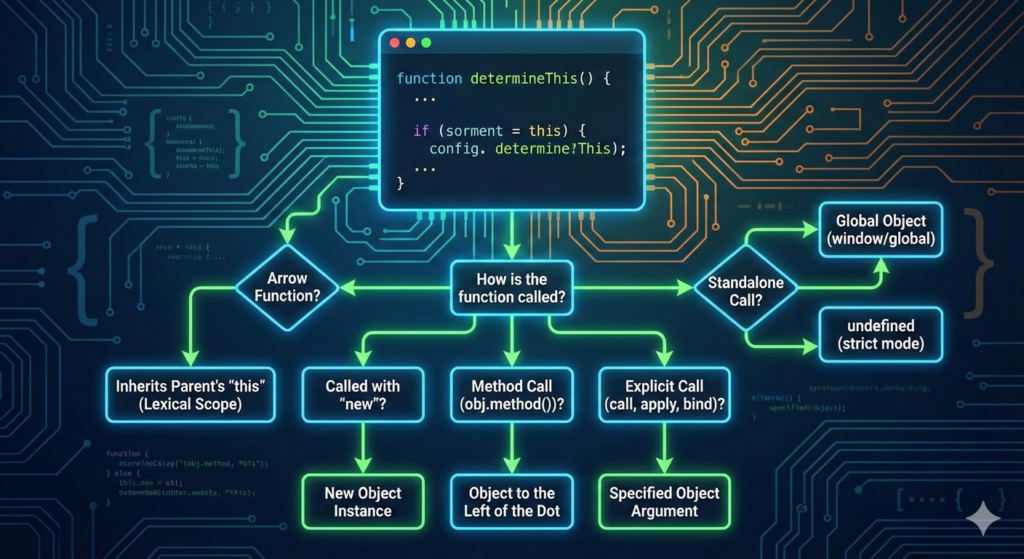
The secret to mastering this is a single sentence: It’s not about where the function is defined; it’s about how the function is called.


1. The Global Context: The Default Setting

When you call a function in the middle of nowhere (the global scope), this has to point somewhere. By default, it points to the “Global Object.”

  • In a browser: this is the window object.

  • In Node.js: this is the global object.

⚠️ The “Strict Mode” Warning: If you are using 'use strict';, JavaScript protects you from accidentally modifying the global object. In strict mode, a standalone function call will result in this being undefined.

function showMe() {
  console.log(this);
}

showMe(); // Window (in non-strict) or undefined (in strict)

2. Implicit Binding: The “Left of the Dot” Rule

This is the most common way you’ll encounter this. When a function is called as a method of an object, this refers to the object to the left of the dot

const skyscraper = {
  floors: 100,
  describe() {
    console.log(`This building has ${this.floors} floors.`);
  }
};

skyscraper.describe(); // "This building has 100 floors."

In this case, skyscraper is to the left of .describe(), so this becomes skyscraper.


3. Explicit Binding: Taking Control

Sometimes, you want to tell a function exactly what this should be, regardless of how it’s called. JavaScript gives us three methods to “force-feed” a context to a function: call(), apply(), and bind().

  • .call() and .apply(): These invoke the function immediately. The only difference is how they handle extra arguments (call takes a list, apply takes an array).

  • .bind(): This is the “stubborn” one. It creates a new function that is permanently bound to the object you provide.

const pilot = { name: 'Maverick' };

function fly() {
  console.log(`${this.name} is taking off!`);
}

const forcedFly = fly.bind(pilot);
forcedFly(); // "Maverick is taking off!"

4. The new Keyword Binding

When you use the new keyword to create an instance of a constructor function or a class, JavaScript does some magic. It creates a brand-new object and tells the function: “For this specific execution, this is that new object you just made.”

function Hero(name) {
  this.name = name;
}

const batman = new Hero('Bruce'); 
// 'this' inside Hero was the brand new 'batman' object.

5. The Modern Game-Changer: Arrow Functions

Introduced in ES6, arrow functions (=>) changed the rules of the game. Arrow functions do not have their own this.

Instead, they use Lexical Scoping. They inherit this from the code that physically surrounds them.

This is incredibly useful for callbacks and timers where this often gets “lost.”

const timer = {
  seconds: 0,
  start() {
    setInterval(() => {
      this.seconds++; // 'this' correctly refers to the timer object
      console.log(this.seconds);
    }, 1000);
  }
};

If we used a regular function above, this would have reverted to the window object, and the timer would have broken!


6. The “Cheat Sheet” for Debugging

When you’re stuck, ask yourself these four questions in order:

  1. Is the function called with new? Then this is the new object.

  2. Is the function called with call, apply, or bind? Then this is the object specified in the parentheses.

  3. Is the function called as a method (obj.method())? Then this is the object before the dot.

  4. Is it an arrow function? Then this is whatever it was in the parent scope.

  5. None of the above? In strict mode, it’s undefined. In non-strict, it’s the window.


Conclusion

Understanding this isn’t about memorizing a complex API; it’s about being a detective and looking at the call-site.

Once you stop looking at where the function was born and start looking at where it’s being executed, the mystery disappears.

Ready to put this into practice?

Try refactoring an old project’s event listeners using arrow functions and see how much cleaner your code becomes!

Useful links below:

Let me & my team build you a money making website/blog for your business https://bit.ly/tnrwebsite_service

Get Bluehost hosting for as little as $1.99/month (save 75%)…https://bit.ly/3C1fZd2

Best email marketing automation solution on the market! http://www.aweber.com/?373860

Build high converting sales funnels with a few simple clicks of your mouse! https://bit.ly/484YV29

Join my Patreon for one-on-one coaching and help with your coding…https://www.patreon.com/c/TyronneRatcliff

Buy me a coffee ☕️https://buymeacoffee.com/tyronneratcliff

 

{ 0 comments }