
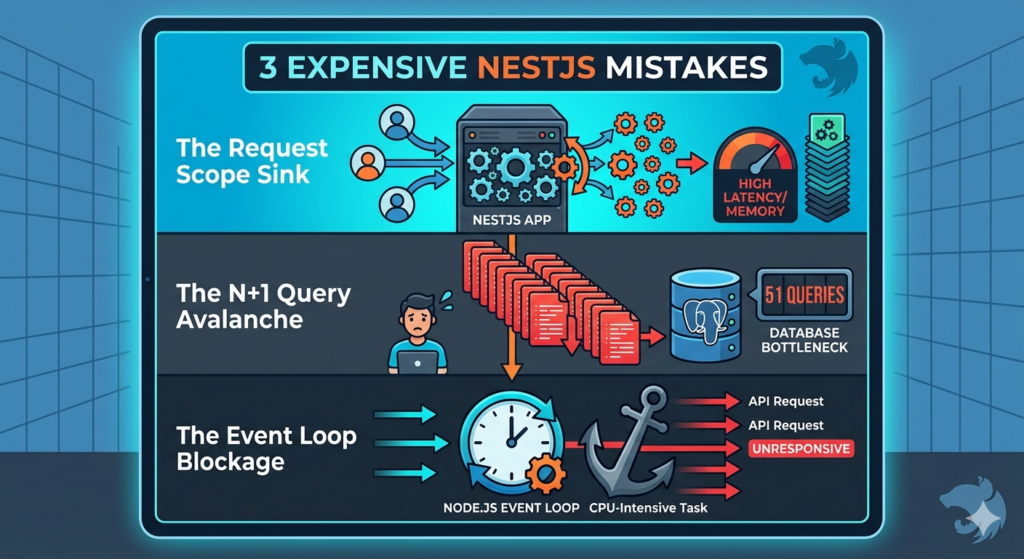
Building a NestJS application is easy; scaling one without a massive cloud bill or a weekend-long outage is the real challenge.
If you’re moving an MVP toward a production-ready system, avoid these three architectural traps.
1. The “Request-Scoped” Performance Sinkhole
NestJS makes it incredibly easy to use @Injectable({ scope: Scope.REQUEST }). While this is tempting for things like logging user IDs or handling multi-tenancy, it comes with a massive performance tax.
The Mistake: Request-scoped providers are re-instantiated for every single incoming request. If you have a deep dependency tree where several services are request-scoped, NestJS spends more time on garbage collection and class instantiation than actually executing your business logic.
The Fix: * Use Singleton Scope (the default) whenever possible.
-
If you need request data (like a User ID), extract it in a Custom Decorator or a Guard and pass it as a function argument rather than injecting it into the service constructor.
-
For multi-tenancy, use a strategy like AsyncLocalStorage to store context without breaking the singleton pattern.
2. The N+1 Query Problem in TypeORM/Prisma
When building complex dashboards or e-commerce feeds, developers often fall into the trap of letting the ORM handle relations lazily or via inefficient loops.
The Mistake: Imagine you’re fetching 50 “Stores,” and for each store, you fetch its “Products.” Without proper optimization, your NestJS app will execute 1 query for the stores and 50 separate queries for the products. In a production environment with high traffic, this will spike your Database CPU to 100% and lead to a “Connection Pool Timeout.”
The Fix:
-
Use Join Aliases: Explicitly use
.leftJoinAndSelect()in TypeORM or theincludeAPI in Prisma. -
DataLoader Pattern: Implement the DataLoader pattern (especially in GraphQL) to batch and cache multiple requests for the same resource into a single SQL
INquery. -
RLS Awareness: If you are using Row-Level Security (RLS), ensure your joins respect the security policies to avoid leaking data across tenants while maintaining performance.
3. Blocking the Event Loop with Heavy Logic
Node.js (and by extension, NestJS) is single-threaded. While it excels at I/O-bound tasks, it struggles with CPU-bound tasks.
The Mistake: Running heavy computations—like image processing, large PDF generation, or complex AI data transformations—directly inside a NestJS controller or service. Because the event loop is blocked, your entire API becomes unresponsive for every other user until that one task is finished.
The Fix:
-
Offload to Worker Threads: Use the
worker_threadsmodule for CPU-intensive logic. -
Task Queues: Use BullMQ with Redis to move heavy tasks to a background worker process. This keeps your API snappy and allows you to scale your “workers” independently from your “web” instances.
-
Serverless Sidecars: For extremely heavy AI-native tasks, consider offloading the logic to a dedicated Cloud Run service or a Lambda function.
Summary for the Production Checklist
Mistake: Request Scoping Impact: High Latency / High Memory Solution: Use Singleton scope + AsyncLocalStorage
Mistake: N+1 Queries Impact: DB Bottleneck / Crashes Solution: Eager loading & DataLoader
Mistake: Blocking Loop Impact: Total API Unresponsiveness Solution: BullMQ or Worker Threads
Final Thought: In production, code that “works” isn’t enough. Code must be resource-aware. By avoiding these three traps, you’ll save yourself thousands in cloud costs and countless hours of debugging.
Useful links below:
Let me & my team build you a money making website/blog for your business https://bit.ly/tnrwebsite_service
Get Bluehost hosting for as little as $1.99/month (save 75%)…https://bit.ly/3C1fZd2
Best email marketing automation solution on the market! http://www.aweber.com/?373860
Build high converting sales funnels with a few simple clicks of your mouse! https://bit.ly/484YV29
Join my Patreon for one-on-one coaching and help with your coding…https://www.patreon.com/c/TyronneRatcliff
Buy me a coffee  https://buymeacoffee.com/tyronneratcliff