
≡ Menu
AI wars

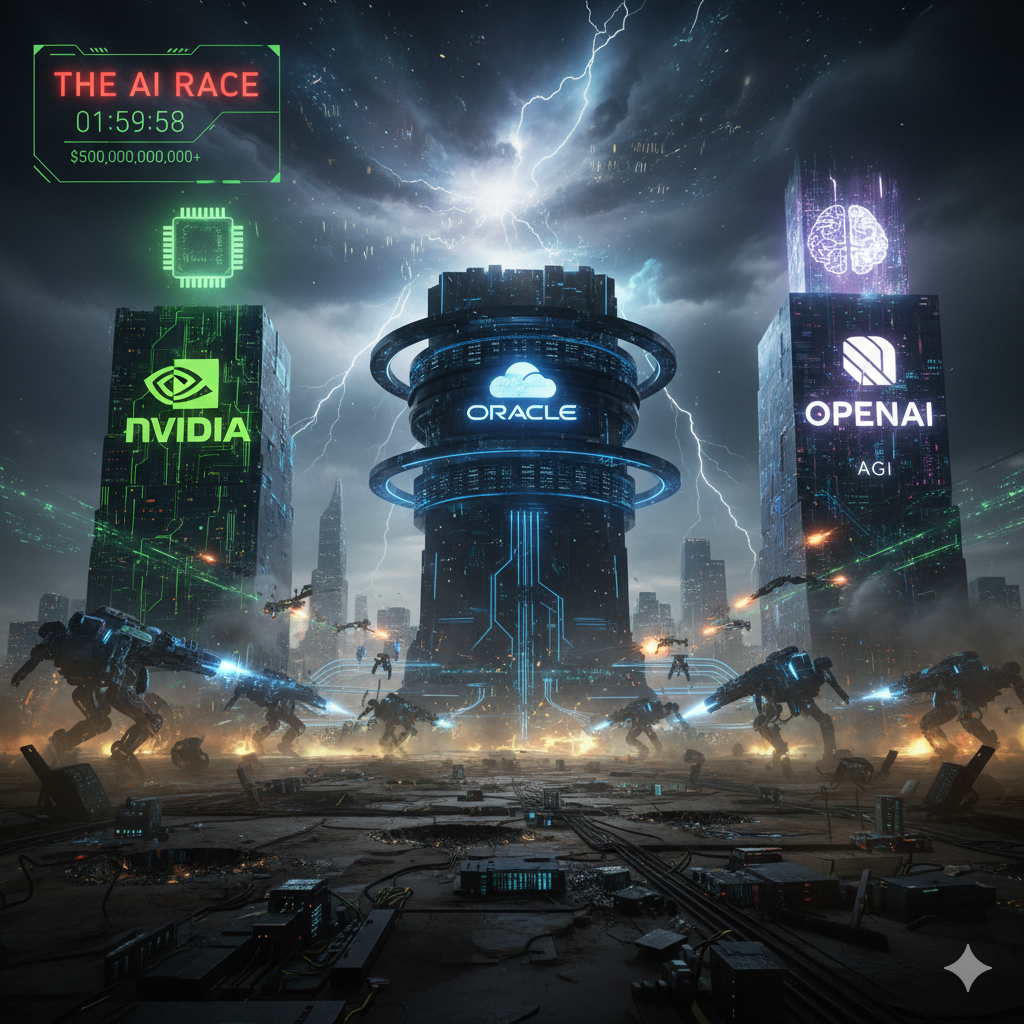
The current AI race is being defined by massive, multi-billion dollar strategic alliances focused on building the computational infrastructure necessary for the next generation of artificial intelligence. At the center of this rapid build-out are Nvidia, Oracle, and OpenAI, whose interlocking partnerships underscore a collective push toward “superintelligence.”


The Core Players and Their Roles

Company Core Role in the AI Race Key Initiative/Partnership
OpenAI AI Innovator and Model Developer Pushing the frontier of AI models (like ChatGPT) toward Artificial General Intelligence (AGI).
Nvidia AI Infrastructure Backbone Dominant supplier of the GPUs and systems critical for training and running advanced AI models.
Oracle Cloud and Data Center Provider Providing the physical cloud infrastructure, power, and data center capacity for massive AI projects.

OpenAI and the Compute Arms Race

OpenAI, the creator of ChatGPT, is in a perpetual quest for more compute—the foundational power needed to train its increasingly complex models and serve its hundreds of millions of users. CEO Sam Altman emphasizes that “everything starts with compute,” positioning infrastructure as the basis for the future economy. To secure this capacity, OpenAI has formed two monumental deals:

  • Nvidia Partnership: A strategic, non-binding letter of intent was recently announced for OpenAI to deploy at least 10 gigawatts (GW) of AI data centers powered by Nvidia systems. Nvidia plans to invest up to $100 billion in OpenAI, progressively, as the new systems are deployed. This circular-funding mechanism—Nvidia invests, and OpenAI uses the capital to buy Nvidia chips—secures a guaranteed customer for Nvidia and essential, preferential access to cutting-edge hardware for OpenAI.
  • Oracle/SoftBank “Stargate” Project: This is a separate, massive-scale infrastructure program that aims to reach 10 GW of power capacity and a total investment of $500 billion. Oracle is a key partner in this initiative, providing the physical data center capacity and cloud services. The project is expanding rapidly, with Oracle-developed sites accounting for several gigawatts of planned capacity.

Nvidia: The Unchallenged AI Hardware King

Nvidia’s graphics processing units (GPUs) are the gold standard for AI model training, making the company an indispensable player. Its strategy has moved beyond just selling chips; it’s now actively investing to secure the future of the AI ecosystem:

  • Securing Demand: The $100 billion investment in OpenAI locks in its most important customer, solidifying its market dominance against rivals. This co-optimization between OpenAI’s software and Nvidia’s hardware is expected to cement a technology advantage.
  • Controlling the Ecosystem: By also investing $5 billion in Intel and collaborating on next-generation chips, Nvidia is hedging its supply chain and ensuring its core technology is integrated across a broader range of AI systems.

Oracle’s Cloud Gambit

Oracle is leveraging the immense power- and space-requirements of large AI models to reposition itself as a top-tier cloud provider for AI infrastructure. By partnering with OpenAI on the multi-billion dollar Stargate project, Oracle has committed to delivering significant data center capacity. This move positions Oracle as a crucial enabler of the AI race, offering a compelling cloud alternative to giants like Microsoft and Amazon for companies that need massive, dedicated AI compute resources.


Implications for the AI Race

The confluence of these deals signals a new phase in the AI race:

  1. Scale and Cost are King: The staggering figures (up to $100 billion from Nvidia, $500 billion for Stargate) indicate that the pursuit of superintelligence requires industrial-scale infrastructure and capital unprecedented in tech history.
  2. Strategic Dependencies: The partnerships highlight a deepening, mutually beneficial dependence: OpenAI needs Nvidia’s chips, and Nvidia needs OpenAI’s demand to drive its growth. Similarly, OpenAI and its partners rely on Oracle’s ability to quickly build and power data centers.
  3. Regulatory Scrutiny: The “circular” nature of the Nvidia-OpenAI deal, and the sheer market dominance of Nvidia, are likely to draw increased antitrust attention from regulators concerned about fair competition in the AI sector.

The video below features the CEOs of Nvidia and OpenAI discussing their monumental partnership.

Nvidia CEO on the $100 billion investment in OpenAI: This partnership is ‘monumental in size’

This video is relevant as it features the chief executives of both Nvidia and OpenAI explaining the context and scale of their strategic $100 billion infrastructure partnership, which is a major development in the current AI race.


{ 0 comments }

New $100,000 H-1B Visa Fee

new h1b visa fee

In an effort to reform the H-1B visa program, the U.S. government has recently introduced a new set of rules that could significantly impact both foreign workers and American employers.

The changes include a substantial new fee and a proposal to alter the visa lottery system.

These measures are designed to curb perceived abuses of the program, protect American jobs, and prioritize higher-skilled and higher-paid foreign workers.


A recent proclamation has introduced a new $100,000 fee for new H-1B visa petitions. This is a one-time fee that employers must pay for each new H-1B petition filed on behalf of a foreign national who is outside the United States.

This fee is separate from and in addition to the other existing H-1B visa fees, which can already be several thousand dollars.

The new rule took effect on September 21, 2025.

The introduction of this massive fee is a dramatic shift in immigration policy.

It is intended to create a significant financial barrier that would discourage companies from using the H-1B program for jobs that could be filled by American workers.

While the government has clarified that this fee does not apply to current H-1B visa holders or to those seeking renewals or extensions, it has sent shockwaves through the tech industry and other sectors that rely on foreign talent.

Small businesses, startups, and non-profits, in particular, may find it difficult or impossible to absorb such a cost, potentially limiting their access to a global talent pool.

The legal standing of this new fee is already being challenged. Immigration attorneys and advocacy groups argue that such a significant fee increase can only be implemented through legislation passed by Congress or a formal rulemaking process that includes a public notice and comment period, not by a presidential proclamation alone.

The outcome of these legal challenges will determine whether the new fee remains in place.


Proposed Changes to the H-1B Lottery System 🗳️


In addition to the new fee, the Department of Homeland Security (DHS) has proposed a major overhaul of the H-1B lottery system. The current system, which is random, would be replaced with a weighted, wage-based selection process. The goal is to prioritize the selection of “high-skilled, high-paid” foreign workers over those at lower wage levels.

Under the new proposal, H-1B registrations would be assigned to one of four wage levels based on the Occupational Employment and Wage Statistics (OEWS) data. The higher the wage level of the position, the more entries the registration would receive in the lottery. For example, a Wage Level IV registration might get four entries, while a Wage Level I registration would only get one.

This change would have a significant impact on who gets selected. Data from DHS shows that under the current system, positions at the highest wage levels are the least represented among approved petitions. The proposed wage-based system aims to reverse that trend, giving employers a strong incentive to offer higher salaries and petition for more senior roles. However, it also means that entry-level workers and recent graduates, even those in legitimate specialty occupations, could see a significant decrease in their chances of being selected. This could disproportionately affect young professionals and startups that cannot compete with the salaries offered by large, established tech companies.

The proposed changes are currently in a public comment period, and it’s expected that they will face legal and procedural challenges similar to the new fee.


What This Means for the H-1B Program’s Future

These H-1B visa changes represent a profound shift in U.S. immigration policy.

The new fee and the proposed lottery reform are part of a broader strategy to make the program more restrictive and more expensive for employers. The changes are a clear signal that the government intends to prioritize what it considers the “best and brightest” talent, while making it more difficult to hire foreign workers for lower-paying positions.

For companies, the financial burden and increased uncertainty may lead to new strategies, such as focusing on domestic hiring, increasing offshoring, or investing in automation. For foreign workers, particularly those hoping to start their careers in the U.S., the path to an H-1B visa has become significantly more challenging and competitive. The future of these rules hinges on the outcome of pending legal challenges and the public’s response during the comment period.

Useful links below:

Let me & my team build you a money making website/blog for your business https://bit.ly/tnrwebsite_service

Get Bluehost hosting for as little as $1.99/month (save 75%)…https://bit.ly/3C1fZd2

Join my Patreon for one-on-one coaching and help with your coding…https://www.patreon.com/c/TyronneRatcliff

Buy me a coffee ☕️https://buymeacoffee.com/tyronneratcliff
{ 0 comments }