
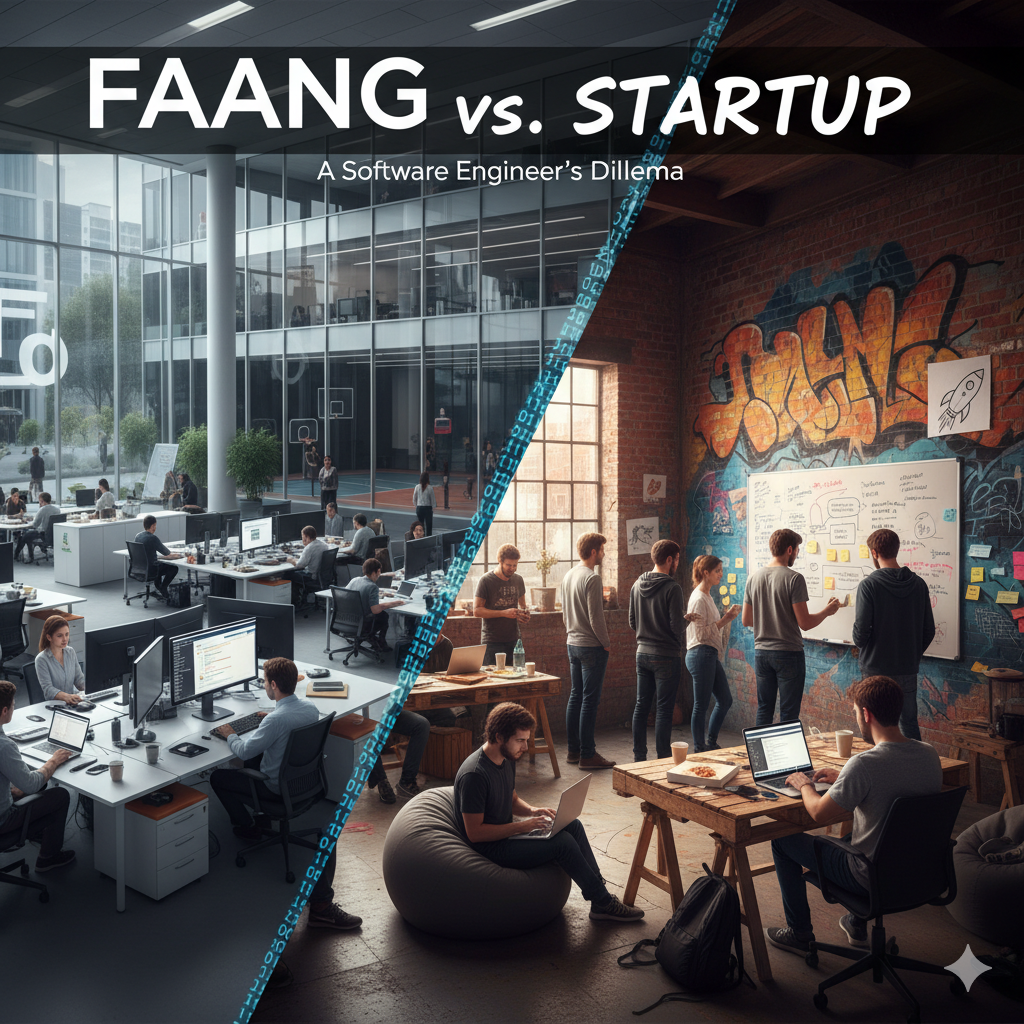
Choosing between a FAANG company (Facebook, Apple, Amazon, Netflix, Google, and often extended to include Microsoft, or “MANGA”) and a software startup is one of the most significant decisions a software engineer will face in their career.
Both paths offer unique advantages and disadvantages, shaping not only your professional trajectory but also your personal life.
This blog post dives deep into the nuances of working for these two vastly different environments, offering insights for engineers at all stages of their careers, from fresh graduates to seasoned professionals.
The Allure of FAANG: Stability, Scale, and Systems
Unmatched Resources and Impact
Working at a FAANG company often means being part of a massive ecosystem that touches billions of users globally.
Imagine contributing to a feature that will be used by a significant portion of the world’s population.
This scale offers a unique sense of impact that few startups can rival.
These companies also boast virtually unlimited resources. From cutting-edge hardware and sophisticated internal tools to vast cloud infrastructure and massive datasets, engineers have access to the best technology money can buy. This allows for innovation at an unprecedented level and provides an environment where engineers can focus on solving complex technical challenges without being constrained by budget or tools.
Structured Career Growth and Learning Opportunities
FAANG companies are known for their well-defined career ladders and robust internal learning and development programs. New hires often go through comprehensive onboarding processes, followed by mentorship programs and regular performance reviews designed to foster continuous growth.
Engineers at FAANGs have opportunities to specialize deeply in areas like distributed systems, machine learning, data science, or front-end architecture. They can also rotate between teams and projects, gaining diverse experiences within the same organization. The sheer number of internal experts and the emphasis on knowledge sharing (through tech talks, internal wikis, and dedicated learning platforms) mean that there’s always an opportunity to learn from the best in the field.
Compensation and Benefits: The Golden Handcuffs
Let’s not shy away from the elephant in the room: compensation. FAANG companies are renowned for their highly competitive salaries, substantial stock options (RSUs), and generous bonuses.
This often results in total compensation packages that can easily reach six or even seven figures for experienced engineers.
Beyond the monetary benefits, FAANGs typically offer a plethora of perks:
- Comprehensive health insurance: Top-tier medical, dental, and vision plans.
- Retirement plans: Generous 401(k) matching.
- On-site amenities: Free gourmet meals,gym memberships, shuttle services, and even nap pods.
- Work-life balance initiatives: While often demanding, many FAANGs offer flexible work arrangements, generous parental leave, and ample vacation time.
These benefits provide a sense of financial security and comfort that can be incredibly appealing, especially for those with families or long-term financial goals.
The Downside: Bureaucracy, Niche Roles, and Slower Pace
However, the FAANG paradise isn’t without its snakes. The very scale that offers impact can also lead to bureaucracy.
Decision-making processes can be slow and involve multiple layers of approval.
Projects might span several quarters or even years, and a single engineer’s contribution might feel like a tiny cog in a giant machine.
Roles can also be highly specialized and siloed. While this allows for deep expertise, it might limit exposure to other aspects of product development, such as design, product management, or business strategy. An engineer might spend years working on a specific microservice or a small component of a large system, potentially leading to a feeling of being pigeonholed.
The pace, while often intense, can sometimes feel slower than a startup. Large codebases, extensive review processes, and a focus on long-term stability can mean that deploying new features takes longer. This can be frustrating for engineers who thrive on rapid iteration and seeing their work quickly come to fruition.
The Startup Scramble: Agility, Ownership, and Rapid Growth
High Impact and Broad Ownership
At a startup, especially an early-stage one, every engineer’s contribution is immediately visible and critical to the company’s survival.
You’re not just building a feature; you’re often building the product, the company, and even the culture. This offers an unparalleled sense of ownership and impact.
Engineers at startups are often full-stack generalists by necessity. They might be involved in everything from front-end development and back-end architecture to database design, deployment, and even customer support. This broad exposure can accelerate learning across various domains and build a more well-rounded skill set. You’ll likely wear many hats, learning not just how to code but also how a business operates.
Rapid Learning and Skill Development
The fast-paced environment of a startup is a crucible for learning. With fewer resources and tighter deadlines, engineers are constantly pushed to innovate, problem-solve creatively, and learn new technologies on the fly.
You’ll often be working with the latest technologies, as startups aren’t burdened by legacy systems to the same extent as established companies. The need to quickly deliver features means you’ll gain hands-on experience with the entire product development lifecycle, from ideation to deployment and post-launch iteration. This rapid iteration and immediate feedback loop can lead to incredibly fast personal and professional growth.
Equity and the Dream of a Big Exit
While base salaries at startups might not initially compete with FAANGs, the real financial upside lies in equity. Stock options in a successful startup can result in life-changing wealth if the company is acquired or goes public.
Beyond equity, many startups offer:
- Flexible work environments: Remote-first cultures, flexible hours, and a focus on output rather than strict adherence to a 9-to-5 schedule.
- A strong sense of community: Smaller teams often foster closer relationships and a more intimate, collaborative culture.
- Direct access to leadership: You’ll likely work closely with founders and executives, gaining insights into business strategy and decision-making.
The potential for a significant financial payoff, combined with the excitement of building something from the ground up, can be a powerful motivator.
The Downside: Instability, Long Hours, and Limited Resources
The most significant risk of working at a startup is instability. A large percentage of startups fail, and even successful ones can face turbulent times. Layoffs are a constant threat, and the financial future of the company (and your equity) is never guaranteed.
Long hours and intense pressure are often part and parcel of startup life. With limited resources and ambitious goals, engineers are frequently expected to work extended hours, including evenings and weekends, to meet deadlines. The line between work and personal life can blur easily.
You’ll also contend with limited resources. This means making do with less, whether it’s older hardware, fewer licenses for premium tools, or a smaller budget for training and development. Engineers might spend more time on operational tasks or workarounds due to a lack of dedicated support teams. The focus is often on speed and functionality over polished perfection, which can sometimes lead to technical debt.
Key Differentiators and Who Should Choose Which Path
| Feature | FAANG | Startup |
| Impact | Deep, specialized impact on massive scale | Broad, direct impact on core product |
| Compensation | High base salary + substantial equity | Lower base salary + high-potential equity |
| Stability | Very high | Low to moderate |
| Work-Life Balance | Generally good, but team dependent | Often challenging, long hours |
| Learning | Structured, specialized, deep dives | Rapid, broad, hands-on, learn-on-the-fly |
| Pace | Deliberate, focused on long-term stability | Fast, agile, rapid iteration |
| Ownership | Specific components, large team | Broad, full-stack, direct responsibility |
| Culture | Corporate, process-driven, structured | Dynamic, chaotic, informal, close-knit |
| Resources | Abundant, cutting-edge | Limited, creative problem-solving required |
| Career Path | Well-defined ladders, internal mobility | Flexible, often self-directed, rapid advancement |
Who is a FAANG for?
- Those seeking stability and high predictable income: If financial security, excellent benefits, and a clear career path are your top priorities.
- Engineers who want to specialize deeply: If you’re passionate about becoming an expert in a specific technical domain like distributed systems, AI, or specific language ecosystems.
- Individuals who thrive in structured environments: If you appreciate clear processes, well-defined roles, and extensive documentation.
- Those interested in large-scale challenges: If the idea of working on systems that serve millions or billions of users excites you.
- Graduates looking for strong foundational training: FAANGs often provide excellent mentorship and training programs for new engineers.
Who is a Startup for?
- Risk-takers seeking high potential upside: If you’re willing to trade some stability for the chance of significant equity payout.
- Generalists who enjoy wearing many hats: If you want broad exposure to different technologies and aspects of product development.
- Individuals who thrive in fast-paced, ambiguous environments: If you’re comfortable with rapid change, making decisions with incomplete information, and directly influencing product direction.
- Those who want to build something from the ground up: If you’re passionate about seeing your work directly impact the company’s success and enjoy the entrepreneurial spirit.
- Engineers looking for rapid career acceleration and leadership opportunities: Startups often provide quicker paths to leadership roles due to their rapid growth and smaller team sizes.
My Personal Take (From Longview, Texas)
Having observed many engineers navigate these choices, both from within large corporations and in the dynamic startup scene, my perspective from Longview, Texas is that the “right” choice is deeply personal and depends heavily on your career stage, financial situation, and what truly motivates you.
For junior engineers, a FAANG can offer an incredible learning experience with structured mentorship and a safety net. The foundational skills, best practices, and exposure to large-scale systems you gain are invaluable. After a few years, armed with this experience, some engineers successfully transition to startups, where they can apply their well-honed skills with greater impact and leadership.
For mid-career engineers, the decision often hinges on whether they prioritize continued specialization and stability (FAANG) or seek broader ownership, direct impact, and the potential for a significant equity payout (startup). This is often the point where engineers evaluate their tolerance for risk and their long-term financial goals.
Senior engineers might find themselves drawn to FAANG for the sheer technical challenge of operating at scale, influencing industry standards, and mentoring large teams. Alternatively, they might join startups as technical leaders or even co-founders, bringing their wealth of experience to bear on building a new venture from the ground up, often with significant equity stakes.
Ultimately, there’s no universally “better” choice. It’s about aligning the opportunity with your personal values and professional aspirations. Both paths offer immense opportunities for growth, learning, and making a significant contribution to the world of software engineering. The most important thing is to understand what each environment offers and how it aligns with where you want to go.
Conclusion
The debate between FAANG and startup is not about which is inherently superior, but about which environment provides the better fit for an individual software engineer at a particular point in their career. FAANGs offer unparalleled resources, structured growth, and significant financial stability, but might come with bureaucracy and specialized roles. Startups provide high impact, rapid learning, and the potential for immense financial upside through equity, but demand resilience in the face of instability and long hours.
Carefully consider your priorities:
- Do you value stability and deep specialization over rapid change and broad responsibility?
- Are you drawn to working on massive, established systems or building something new from the ground up?
- Is predictable, high compensation more important than the high-risk, high-reward potential of equity?
Answering these questions honestly will guide you toward the path that will not only advance your career but also bring you professional fulfillment. Both journeys are arduous, but also incredibly rewarding in their own unique ways. Choose wisely, and happy coding!